History of Arsenal F.C. (1886–1966)
The
history of Arsenal Football Club between 1886 and 1966
covers their time from the club's foundation, through the first two
major periods of success (the 1930s, and the late 1940s and early 1950s,
respectively) and the club's subsequent decline to mid-table status in
the 1960s.
Arsenal Football Club were founded in 1886 as a workers' team from
Woolwich,
South East London. They turned professional in 1891 and joined the
Football League two years later. They were promoted to the
First Division in 1904 but financial problems meant they were close to bankruptcy by 1910. They were bought out by
Sir Henry Norris that year and to improve the club's financial standing, he moved the team to
Arsenal Stadium,
Highbury,
North London in 1913. After
World War I he arranged for the club's promotion back to the First Division, in controversial circumstances.
It was not until the appointment of
Herbert Chapman
that Arsenal had their first period of major success; Chapman
modernised and reformed the club's practices and tactics, and under him
and his successor
George Allison (who took over after Chapman's death in 1934), Arsenal won five First Division titles and two
FA Cups in the 1930s. After the
Second World War,
Tom Whittaker
continued the success, leading the club to two First Division titles
and an FA Cup. After Whittaker's death Arsenal's fortunes gradually
declined; by 1966, they were in mid-table obscurity and had not won a
trophy in thirteen years. This led to the dismissal of
Billy Wright as manager in 1966, and with it the appointment of
Bertie Mee, who would go on to turn around the club's fortunes
Early years (1886–1910)

Royal Arsenal's squad of the
1888–89 season
Arsenal were founded as
Dial Square in 1886 by a group of workers employed by the Dial Square workshop at the
Royal Arsenal, an
armaments factory in
Woolwich, southeast London.
[1] They were led by a
Scotsman,
David Danskin, who purchased the club's first
football, and
Jack Humble; amongst their number was former
Nottingham Forest goalkeeper Fred Beardsley, who would later along with
Morris Bates obtain a set of red kits from his old club, thus giving Arsenal the colours they still wear today.
[2]
Dial Square played their first match on 11 December 1886 against Eastern Wanderers on an open field in the
Isle of Dogs, which they won 6–0.
[3] The club were renamed
Royal Arsenal soon after, reportedly on
Christmas Day.
[2] Initially the club played on
Plumstead Common, but soon sought alternative homes, firstly the Sportsman Ground in
Plumstead before moving to the adjacent
Manor Ground in 1888. Unhappy with the Manor Ground's poor facilities, the club moved to the nearby
Invicta Ground in 1890, before returning to the Manor Ground three years later as the Invicta Ground's rent proved too expensive.
[4]
During this period, Royal Arsenal started to win local trophies, winning both the
Kent Senior Cup and
London Charity Cup in
1889–90 and the
London Senior Cup in
1890–91; they also entered the
FA Cup for the first time in 1889–90.
[5] However, the gulf between Arsenal and the professional sides from
the North
soon became apparent, and Arsenal faced the threat of their amateur
players being lured away by the money professional sides could offer;
after
Derby County had played Arsenal in an FA Cup tie in 1891, they attempted to sign two of Arsenal's amateur players on professional contracts.
[4]
Royal Arsenal's move to professionalism in 1891 was frowned upon by
many of the amateur southern clubs, and they were banned from
participating in local competitions by the
London Football Association.
[6]
With friendlies and the FA Cup the only matches available for Royal
Arsenal, they attempted to set up a southern equivalent of the
Football League, but the move failed.
[6]
The club changed its name to Woolwich Arsenal in 1893 when it formed a
limited liability company to raise capital to purchase the Manor Ground.
[7]
Woolwich Arsenal's future looked bleak until the Football League came
to their rescue by inviting them to join in 1893. Arsenal were the first
Southern club to enter the League, initially joining the
Second Division;
in response, some of the club's amateur players who rejected
professionalism and wanted a workers' team to represent just the Royal
Arsenal, broke away to form a short-lived alternative side,
Royal Ordnance Factories.
[8]
Woolwich Arsenal played in the Second Division for eleven seasons, and generally occupied mid-table before the appointment of
Harry Bradshaw as manager in 1899;
[9] Bradshaw and his star signings, including goalkeeper
Jimmy Ashcroft (Arsenal's first
England international) and captain
Jimmy Jackson, won promotion to the
First Division in
1903–04. However, Bradshaw moved on to
Fulham
in May 1904, before the Gunners had kicked a ball in the top flight.
Despite some strong performances in the FA Cup – the club reached the
semi-finals in
1905–06 and
1906–07[9] –
Arsenal were never able to challenge for the League title, only twice
finishing above tenth place in the First Division between 1904 and 1913.
The chief cause of this decline was the club's ongoing financial
problems; despite the boom in football during the early 20th century,
the club's geographic isolation, in the relatively underpopulated area
of Plumstead (then on the outskirts of urban London), meant attendances
and thus income were low.
[10] To stay afloat, Woolwich Arsenal were forced to sell their star players (including Ashcroft, as well as
Tim Coleman and
Bert Freeman),
and slowly started to slip down the table, which compounded their
financial situation as crowds fell. By the end of the decade the average
attendance at Manor Ground was 11,000, a little over half of what it
was in 1904.
[11] The club were close to
bankruptcy, and in 1910 went into voluntary
liquidation before being bought out by a consortium of businessmen; the largest shareholder amongst the new owners was property magnate
Sir Henry Norris, who was also chairman of
Fulham.
[12]
The novel "Making the Arsenal" by Tony Attwood, (published by First
and Best, www.woolwicharsenal.co.uk) includes the argument that crowds
at Woolwich Arsenal were down in 1910 because of the closure of the
torpedo factory and its removal to the Clyde that year. It also suggests
that after Norris failed to get an agreement to amalgamation with
Fulham he instead sought to have Woolwich Arsenal play at Craven Cottage
on alternative Saturdays. This plan was abandoned when he was forced to
agree that Woolwich Arsenal would stay at the Manor Ground for at least
two years from the summer of 1910.
Move to Highbury (1910–25)
Norris was acutely aware of the problems associated with Woolwich
Arsenal's location, and was desperate to improve the club's income.
First, Norris tried to merge Woolwich Arsenal with his other club,
Fulham. When that was blocked by the Football League, Norris abandoned
the merger and looked to move the club elsewhere, eventually picking a
site in
Highbury,
north London. Despite objections both from Woolwich-based fans and residents of Highbury,
[13] Norris tenaciously saw the move through. He reportedly spent £125,000
[14] (approximately £8.2m in 2005 prices
[15]) on building the new stadium, designed by
Archibald Leitch, on a
divinity college's
playing fields. Woolwich Arsenal moved there in the 1913
close season, having finished bottom and relegated back to the Second Division in
1912–13.
[9] They replaced the "Woolwich" in their name with "The" in April 1914, finally becoming plain "Arsenal" in November 1919,
[16] although the press at the time continued to refer to them as "The Arsenal".
[14]
The club controversially rejoined the First Division in 1919,
[17][18] despite only finishing sixth in
1914–15, the last season of competitive football before the
First World War had intervened — although an error in the calculation of
goal average meant Arsenal had actually finished fifth,
[19] an error which was corrected by the Football League in 1975.
[20] The First Division was being expanded from 20 teams to 22, and the two new entrants were elected at an
AGM of the Football League. One of the extra places was given to
Chelsea,
who had finished 19th in the First Division and thus had been already
relegated. The other spot could have gone to 20th-placed
Tottenham Hotspur (also relegated), or to
Barnsley or
Wolves, who had finished third and fourth in the Second Division respectively.
[19]
Instead, the League decided instead to promote sixth-placed Arsenal,
for reasons of history over merit; Norris argued that Arsenal be
promoted for their "long service to league football", having been the
first League club from the South.
[18] The League board agreed; they voted eighteen votes to eight to promote Arsenal ahead of their local rivals Tottenham Hotspur,
[17]
which has fuelled the long-standing enmity between the two clubs. It
has been alleged that this was due to backroom deals or even outright
bribery by Sir Henry Norris,
[17] colluding with his friend
John McKenna, chairman of
Liverpool and the Football League, who recommended Arsenal's promotion to the AGM.
[17]
No conclusive proof of wrongdoing has ever come to light, though
other aspects of Norris's financial dealings unrelated to the promotion
controversy have fuelled speculation on the matter; Norris resigned as
chairman and left the club in 1929, having been found guilty by
the Football Association
of financial irregularities; he was found to have misused his expenses
account, and to have pocketed the proceeds of the sale of the Arsenal
team bus.
[21]
Regardless of the circumstances of their promotion in 1919, Arsenal
have remained in the top division since then, and as a result hold the
English record for the longest unbroken stretch of top-flight football.
[22]
The move to Highbury brought about much larger crowds; the average
attendance in Arsenal's first season at Highbury was 23,000 (compared to
11,000 at the Manor Ground) and rose further after promotion in 1919,
finally warding off the spectre of financial ruin.
[23] However, Arsenal's return to the First Division was not immediately successful. Under
Leslie Knighton, the club never finished better than ninth, and in
1923–24 came close to returning to the Second Division, finishing 19th and only a point clear of the relegation zone.
[24] Arsenal did no better
the following season,
finishing 20th (although paradoxically the club were a lot safer this
time, being seven points clear of the relegation places), which was the
last straw for Norris; he fired Knighton in May 1925,
[25] and appointed the
Huddersfield Town manager,
Herbert Chapman in his place.
There appears to be no extant records of the meetings which elected
Arsenal to the First Division in 1919, however the web site "Making the
Arsenal" proposes a different reason for their election in that year.
The site argues that the match fixing issues of the final year of
football before the war (1914/15) were used by Norris as a weapon in his
battle to get Arsenal promoted. He demanded that Liverpool and
Manchester United (who had been found guilty of match fixing) be
punished by relegation or expulsion, and threatened to organise a
breakaway from the league by midlands and southern clubs if nothing was
done. To placate him the League offered Arsenal a place in the First
Division.
The Chapman era (1925–34)

Herbert Chapman's achievements are commemorated by a bronze bust inside the marble hall of Arsenal Stadium.
Chapman reformed many of the club's practices, including modernising
the training and physiotherapy regimes, adding numbers to the players'
shirts in August 1928,
[26]
and changing the team's colours, adding white sleeves to the red shirt
in March 1933. Chapman also insisted on journalists dropping the
definite article from the club's name, becoming just "Arsenal", and he successfully campaigned for the renaming of the local
Tube station,
Gillespie Road, to
Arsenal.
[27]
At the same time, Chapman had a large transfer budget by virtue of
Arsenal's improved revenue from their new stadium and a change of heart
from Henry Norris; previously a highly prudent chairman, Norris now
dictated that there was to be heavy spending on new players.
[28]
Chapman's first signing was veteran
Charlie Buchan from
Sunderland; as well as his contributions on the pitch, Buchan would play an important part off it. After Arsenal were beaten 7–0 by
Newcastle United in October 1925, Buchan suggested a change to the formation to adapt to a relaxation of the
offside law, adjusting Arsenal's
formation to the "
WM", strengthening the defence by pushing the
centre half back into defence and the
full-backs out to the wings.
[29] Over time, Chapman developed the formation further, putting an emphasis on a pacy forward line,
wingers cutting inside, and the role of a creative ball-playing
midfielder.
[30]
Arsenal came second in Chapman's
first season, their best ever finish at that time,
[31]
but this proved to be a false dawn; for the next few seasons they
stayed in mid-table as Chapman took his time to assemble his side,
slotting new signings such as winger
Joe Hulme, forward
Jack Lambert and defenders
Tom Parker and
Herbie Roberts into his new formation. In
1926–27, Arsenal reached their first FA Cup final, only to
lose 1–0 to
Cardiff City, after Arsenal's goalkeeper
Dan Lewis let a harmless-looking shot slip through his arms and into the net;
[32][33] it was the only occasion in history that the FA Cup has been won by a club from outside England.
[34]
Chapman was not deterred, and continued to build his side, signing future captain
Eddie Hapgood, as well as three of the club's great attacking players,
David Jack,
Alex James and
Cliff Bastin;
it was especially Alex James, Arsenal's playmaker in midfield,
supplying the forward line and wingers, who became celebrated as the
engine of the team.
[35] Three years after their first Cup final, in
1929–30, Arsenal reached Wembley again, this time up against Chapman's old club Huddersfield Town.
The match was notable for being "buzzed" by the enormous German
airship Graf Zeppelin.
Arsenal were not distracted from their task; they won 2–0 with goals
from James and Lambert to bring home the club's first major trophy.
On 30 August 1930, Arsenal helped create a new attendance record of 28,723 at Blackpool's
Bloomfield Road ground. They helped set it again over the next two seasons with crowds of 29,576 and 30,218.
[36]
Their FA Cup success was the first in a decade in which Arsenal were
the dominant club in England. They won the First Division for the first
time in
1930–31; Arsenal performed strongly in a free-scoring title race with
Aston Villa, recording several heavy wins (including 7–1
v. Blackpool, 7–2
v. Leicester City, and 9–1
v Grimsby Town,
which remains a club record for the top flight). Arsenal won the title
with two games to spare, and finished the season having scored 127
league goals (another club record), though Aston Villa managed to score
128, which is still a record for the most goals in an English top flight
season.
The following season,
1931–32, Arsenal reached the FA Cup final again,
losing controversially to
Newcastle United. Arsenal had led 1–0 with a
Bob John goal, but Newcastle's equaliser came after a long ball had gone over the goal line, and out for a goal kick;
[37] Newcastle winger
Jimmy Richardson nevertheless crossed the ball back into play and
Jack Allen
levelled the match for the Magpies; Allen scored again in the second
half to win the match 2–1. Arsenal's pain was compounded by the fact
that
Everton had pipped them to the League title; a poor start to the
1931–32 campaign meant Arsenal played catch-up for most of the season, finishing two points adrift.
[38]
Arsenal bounced back
the following season,
winning their second League title. Arsenal had started the season
weakly, but then went on a long winning run to catch up and then
overtake fellow title challengers Aston Villa, whom they beat 5–0 at
Highbury in April to clinch the title.
[39] By this time Chapman's first set of signings had started to show their age
[40] so with an eye to the future Chapman promoted
George Male to the first team to replace Tom Parker, and signed
Ray Bowden to take over from David Jack. The only blot on the club's record was an infamous loss to
Walsall of the
Third Division North in the FA Cup; five of the first team were out with injury or
flu and had their place taken by reserves,
[41] but despite six first-team players Arsenal lost 2–0 in one of the greatest FA Cup upsets of all time.
[42] One of the stand-ins,
Tommy Black, was particularly to blame (conceding a
penalty for Walsall's second), and was sold by an enraged Chapman to
Plymouth Argyle within a week of the result; another, striker
Charlie Walsh, was transferred to
Brentford a week later.
[43]
A hat-trick of League titles (1934–39)
Arsenal had started the
1933–34 season solidly, but in January 1934 Herbert Chapman died suddenly from
pneumonia. Despite this, under
caretaker manager Joe Shaw
Arsenal retained the title that season; Hulme and James were both out
with injury for a large portion, and so Arsenal were not the attacking
side they had been the previous season, scoring only 75 in the League,
compared with 118 in 1932–33.
[31]
George Allison
(who had formerly been a director of the club) took over the job of
team manager in summer 1934 and soon signed new blood for the side,
including wing halves
Jack Crayston and
Wilf Copping (whose signings had been initiated by Chapman), and striker
Ted Drake.
[39] With these new signings, Allison oversaw the completion of a
hat-trick of League titles in
1934–35,
and Arsenal were back to their attacking best; Drake scored a club
record 42 league goals that season and Arsenal racked up a series of
heavily one-sided scorelines reminiscent of the 1930–31 season
(including 7–0
v. Wolves, 8–1
v. Liverpool, and 8–0 twice,
v. Leicester City and
v. Middlesbrough).
[44] Such was Arsenal's strength that in November 1934, seven players that started for the
England side that beat
World Champions Italy 3–2 (in the so-called "
Battle of Highbury") were on Arsenal's books, a record number of players from a single club, which still stands today.
[45]
Arsenal's ongoing success attracted larger and larger crowds.
Arsenal's home, Highbury, was completely redeveloped, with Leitch's
stands from 1913 demolished and replaced with modern
Art Deco stands, parts of which remain to this day — the façade of the East Stand is now a Grade II
listed building,
[46] and both façades have been retained as part of the modern-day redevelopment of Highbury into an
apartment complex.
Meanwhile, the North Bank and Clock End terraces had roofs installed.
The new stadium saw its largest ever attendance, 73,295, on 9 March 1935
for a match against
Sunderland.
[47]
Arsenal's dominance of the decade was sealed with a second FA Cup in
1935–36,
winning 1–0 against
Sheffield United
with a goal from Drake. Arsenal faded in the League somewhat after the
1934–35 title, and were weakened by the retirement of Alex James and the
club's inability to replace him, as well as long-term injuries to
several other key players such as Herbie Roberts and Joe Hulme.
Nevertheless, they won a fifth League title in
1937–38, pipping
Wolves on the final day of the season, to cap off a highly successful decade.
The Second World War (1939–45)
Soon after the outbreak of the
Second World War in 1939, all first-class football in Britain was suspended, and the
1939–40 Football League season annulled. Highbury was requisitioned as an
ARP station, with a
barrage balloon operating behind the Clock End. During
the Blitz,
a bomb fell on the North Bank, destroying the roof and setting fire to
the scrap that was being stored on the terrace. With Highbury closed,
Arsenal instead played their home matches at
White Hart Lane, home of their rivals Tottenham Hotspur.
[48]
Wartime matches do not count in official statistics; competitions were
played on a regional basis and teams often did not complete a full
season; many footballers served in the armed forces as trainers or
instructors and were away from their clubs for long periods of time, so
they would often star as "guests" at other clubs. Arsenal won the
Football League War Cup South in
1942–43 and the London or Southern league titles in
1939–40,
1941–42 and
1942–43.
[49] Participation in the London League led to their expulsion from
the Football League
in 1941 along with 14 other clubs; it was not until April 1942 when
they were readmitted after expressing regret and paying a £10 fine.
[50]
In November 1945, with league competition still suspended, Arsenal were one of the teams that played a
Dynamo Moscow
side touring the UK. With many players still serving abroad in the
armed forces, Arsenal were severely depleted and used six guest players,
including
Stanley Matthews and
Stan Mortensen, which led Dynamo to declare they were playing an
England XI,
[51] although three of the side were actually
Welsh. In any case, Dynamo themselves had
Vsevolod Bobrov on loan from
CDKA Moscow.
[52] The match, at White Hart Lane, kicked off in thick
fog and the slick and technically proficient Dynamo won 4–3, after Arsenal had led 3–1 at half-time.
Though the score is generally agreed upon, after that accounts of the
match diverge; even the identity of the goalscorers is disputed.
[53] English reports alleged Dynamo fielded twelve players at one point, and tried to pressurise the
referee
into abandoning the match when they had been behind; in turn, the
Soviets accused Arsenal of persistent foul play and even alleged George
Allison had bet money on the result (a claim that was later retracted).
[54] The acrimony after the match was such that it inspired
George Orwell to write his 1945 essay
The Sporting Spirit, in which he famously opined on the
nature of sport, namely that in his view "it is war minus the shooting".
[55] With the fog obscuring much of the action, not to mention the language barriers and the early-
Cold War mutual suspicion between both sides, it is unlikely any reliable account of the match will ever emerge.
The post-war years (1945–66)
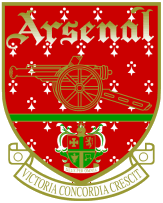
Arsenal adopted this red
crest in 1949, which was a familiar sight until its replacement in 2002.
The war had claimed the lives of nine Arsenal first team players, the most of any top flight club,
[56]
and the intervening time had cut short the careers of several others,
including Bastin and Drake. Additionally, the debts from the
construction of Highbury and the costs of repairing war damage were a
heavy financial burden, and Arsenal struggled at first when competitive
football resumed in 1946. They lost 6–1 on
aggregate to
West Ham United in the third round of the
1945–46 FA Cup, and upon the league's resumption in
1946–47 the club finished 13th, their worst in 17 years.
[31] George Allison decided to retire from football at the end of that season, and was replaced by his assistant
Tom Whittaker, a long-time servant of the club who had been trainer under Chapman.
Whittaker enjoyed immediate success, winning the League title in
1947–48; led by captain
Joe Mercer's strong defence and with goals from attacking front two of
Reg Lewis and
Ronnie Rooke, Arsenal were top of the table from October until the season's climax, winning by a seven point margin.
[57] However, given the age of the Arsenal side at the time (Rooke and Mercer were both over thirty, as were
Denis and
Leslie Compton), long-term success was not possible. In response, Whittaker had brought in younger players such as
Doug Lishman,
Alex Forbes and
Cliff Holton.
[58] Although Arsenal were unable to sustain any challenges for the League title, with the new blood they won the FA Cup in
1949–50, with Reg Lewis scoring both goals in
a 2–0 win over Liverpool.
The
1951–52
season saw the club nearly win the Double, but ultimately end up
empty-handed; a series of injuries and a fixture pile-up at the end of
the season saw Arsenal lose their last two matches, including the title
decider against eventual champions
Manchester United at
Old Trafford on the last day of the season;
[59] after losing 6–1, the Gunners finished third, equal on points with Tottenham.
[60] A week later, Arsenal played Newcastle United in the
1952 FA Cup Final, with several recovering players rushed back into the first team;
Walley Barnes was taken off injured with a twisted knee after 35 minutes (no
substitutes were allowed then), and ten-man Arsenal suffered further injuries to Holton,
Roper and
Daniel, so that by the end of the match they had only seven fit players on the pitch;
[61] with the numerical advantage in their favour, Newcastle won 1–0 with a goal from
George Robledo.
Despite the disappointment of the previous season, Arsenal won their seventh League title in
1952–53; in one of the closest title races ever, they beat
Preston North End to the title on
goal average after finishing level on points.
[62] The title looked to be Preston's after Arsenal lost to them 2–0 at
Deepdale in the penultimate game of the season, but Arsenal came from behind to beat
Burnley 3–2, to take the title on 0.099 of a goal.
[63]
That proved to be Arsenal's last trophy for seventeen years, as
Arsenal's fortunes began to wane, particularly after the unexpected
death of Tom Whittaker in October 1956.
As the club's fortunes declined, they found themselves unable to attract many stars (Welsh international goalkeeper
Jack Kelsey being a notable exception), while up and coming players such as
David Herd left for more successful clubs.
Jack Crayston and
George Swindin, both former players, followed Whittaker but could not replicate his success. Apart from finishing third in
1958–59 and fifth in both
1955–56 and
1956–57, Arsenal usually finished in mid-table.
[31]
Nor did the club have much luck in the FA Cup — after reaching the
final in 1951–52, Arsenal would not get beyond the quarter-finals again
until
1970–71.
[31] To make matters worse for the club, up the road their fierce rivals Tottenham Hotspur won the Double in
1960–61.
In 1962, Arsenal made the bold but ultimately unsuccessful step of appointing former England and Wolves captain
Billy Wright
as manager, despite his lack of managerial experience and the fact he
had no prior experience with the club. Like his two immediate
predecessors, Wright was not very successful, although it was under his
leadership that the club made their debut in
European competition, in the
1963–64 Inter-Cities Fairs Cup after finishing seventh in
1962–63.
[31] In
his final season,
Arsenal finished 14th, their lowest position in 36 years, and recorded
the lowest-ever attendance at Highbury — 4,554 in a match against
Leeds United on 5 May 1966.
[47][64] The only Arsenal player to figure in England's
1966 FIFA World Cup-winning squad was
George Eastham, who did not play at all during the tournament.
[65] Wright was dismissed by the Arsenal board in the summer of 1966,
[66] and was replaced by club
physiotherapist Bertie Mee.
Though the club's directors did not know it at the time, Mee would turn
around the club and lead them to success both in Europe and at home
within the next five years.


